Atlanta Venues

Gateway Center Arena at College Park: Exhibit Planning and Coordination for Atlanta Airport Corridor Events

Atlanta booth planning, fabrication, logistics, and show-floor control.

Authoritative guidance on aligning custom exhibit strategies with the operational realities of one of Atlanta’s key airport-adjacent venues.

Venue typearena-scale brand presentation
Early focushouse power, rigging limits, floor protection, and premium access timing
Show-day pressuretight show calls, audience surges, and security-sensitive loading rules

The Strategic Value of Atlanta’s Airport and College Park Event Zone

Atlanta’s trade show and event demand divides into four distinct operating zones, with the airport and College Park corridor serving fly-in conferences, fast-turn meetings, and programs that prioritize transportation efficiency. The Gateway Center Arena contributes to this zone by offering an arena environment capable of hosting dynamic general sessions and brand experiences that might exceed the spatial or atmospheric parameters of standard convention facilities. Its placement on Convention Center Concourse creates natural synergy with nearby venues, enabling planners to construct multi-site events without introducing significant transit friction for participants arriving by air.

This corridor contrasts with downtown Atlanta’s flagship district, where the Georgia World Congress Center, Centennial Olympic Park, and AmericasMart generate dense exhibit and buyer-showroom activity. Airport-adjacent venues instead emphasize convenience for time-sensitive national and international audiences who value direct SkyTrain access from arrival gates. The Gateway Center Arena supports this model by accommodating high-energy formats that leverage the arena’s scale for memorable openings, keynotes, and experiential activations. Coordination efforts in this zone therefore focus on synchronizing transportation, programming flow, and spatial requirements across a compact campus rather than navigating downtown’s larger footprint.

Market patterns indicate that successful programs in College Park often blend corporate, association, and brand-driven elements. The arena’s relevance increases when events require both large-scale presentation capabilities and adjacent spaces for interactive exhibits. Planners who map these requirements early can better align their exhibit strategies with the venue’s operational strengths, creating smooth transitions between educational sessions and branded engagement areas while minimizing attendee downtime.

Operational Nuances Specific to the Gateway Center Arena

The arena’s location at 2330 Convention Center Concourse in College Park directly ties it to the operational advantages shared with the Georgia International Convention Center, most notably ATL SkyTrain connectivity. This linkage allows attendees to transition from airport concourses to arena entrances within minutes, supporting tighter event schedules and reducing the logistical overhead associated with off-site shuttles or urban traffic. For coordinators, this means programming can begin earlier and run more efficiently, with less buffer time allocated to transportation.

As an arena-event venue, the arena introduces spatial and experiential considerations that differ from flat-floor convention halls. High ceilings, tiered seating options, and expansive floor areas favor activations that incorporate vertical design elements, dynamic lighting, and large-scale visuals to engage audiences across varying distances. General sessions often serve as the core program component, with surrounding pre-function spaces providing natural locations for supporting exhibits and brand interactions. Understanding these flow patterns helps planners position custom environments where they enhance rather than interrupt primary activities.

The venue’s airport-corridor context also influences load-in, setup, and attendee movement patterns. Programs that spill beyond the GICC footprint frequently utilize the arena for evening receptions, award ceremonies, or high-impact brand launches that benefit from its energetic atmosphere. Coordination teams must therefore account for multi-venue attendee routing, shared infrastructure along the concourse, and the need for clear wayfinding that directs participants between sites without confusion. These operational details become central to maintaining program momentum and maximizing the impact of every square foot of exhibit space.

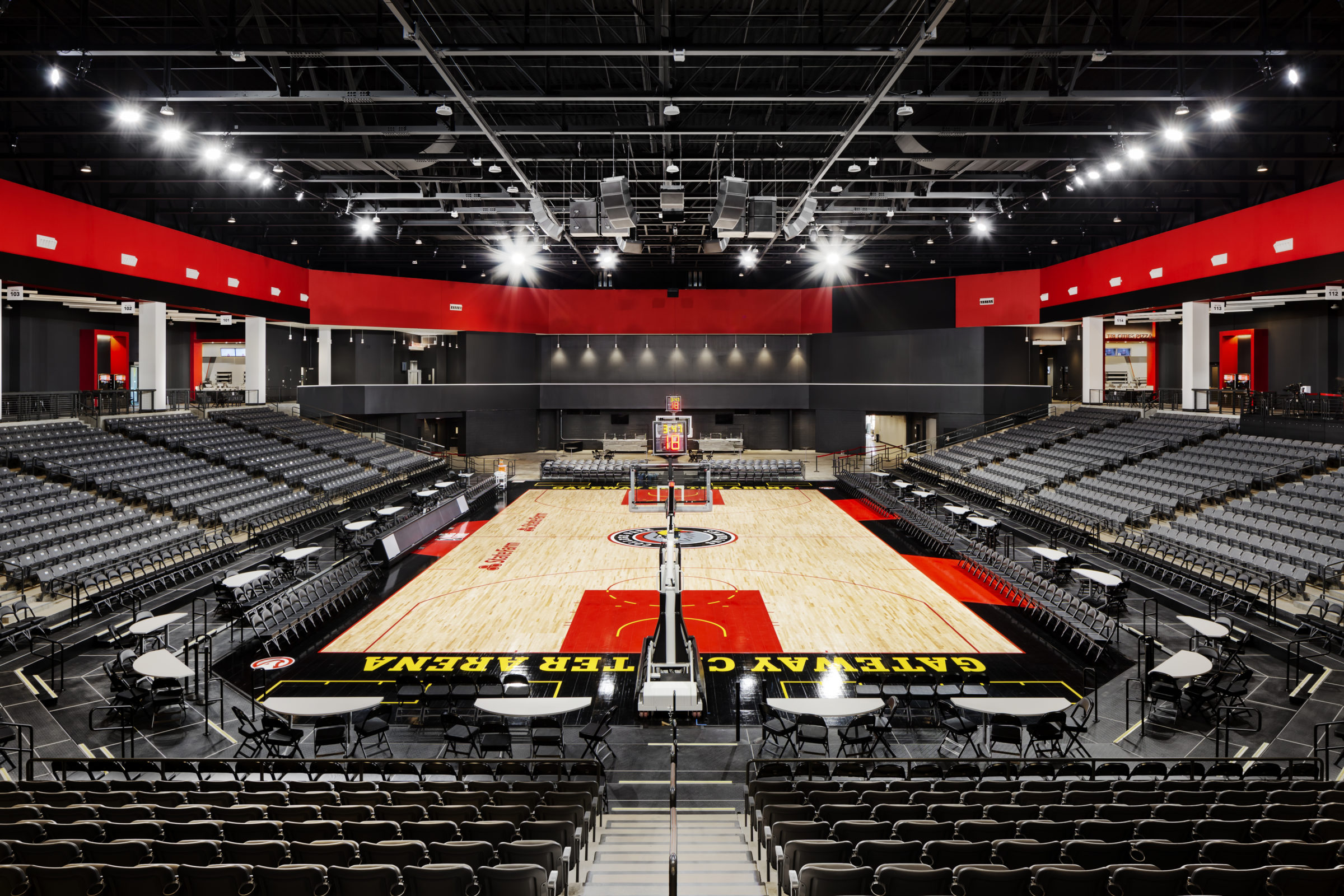
Exhibit and Activation Strategies Suited to Arena Environments

Arena settings demand exhibit approaches that scale appropriately to the venue’s volume and audience dynamics. At the arena, successful brand activations typically combine bold architectural statements with interactive components that draw attendees from general session areas into conversational zones. The high-energy nature of many programs here rewards designs that incorporate motion, lighting, and technology without overwhelming the primary presentation space. Planners benefit from mapping sightlines early to ensure exhibits complement rather than compete with stage presentations.

Modular and reconfigurable systems often prove advantageous in this corridor, where events may require rapid transitions between formats or shared usage with sports-adjacent activations. Custom components can be tailored to highlight key brand messages while remaining adaptable to the arena’s unique dimensions and power access points. The goal remains creating environments that facilitate meaningful engagement during breaks, networking periods, and dedicated activation windows. This approach aligns with the fast-turn character of many airport-zone events, where efficiency from concept through execution determines overall success.

Coordination resources emphasize early integration of exhibit plans with venue programming timelines. By aligning design decisions with known general session schedules and expected attendance flows, organizers can optimize placement, graphics scale, and experiential elements for maximum visibility. The arena’s role in supporting both large-scale gatherings and intimate breakout experiences allows for layered strategies—monumental structures for broad appeal paired with targeted demonstration areas that encourage deeper interaction. These layered tactics help differentiate programs in a market where attendees often move between multiple Atlanta venues during a single trip.

Maximizing ATL SkyTrain Connectivity in Event Logistics

The ATL SkyTrain represents a defining operational advantage for events at the arena and surrounding College Park facilities. This direct rail connection from Hartsfield-Jackson Atlanta International Airport terminals eliminates many traditional pain points associated with attendee arrival, allowing planners to schedule content with greater precision. For national and international events, this connectivity broadens the pool of feasible speakers, exhibitors, and attendees who might otherwise hesitate due to lengthy transfer times.

Logistical planning therefore shifts focus from transportation management to on-site experience optimization. Coordinators can allocate saved time toward productive programming rather than buffer periods, creating denser schedules that maintain attendee energy levels throughout the day. Exhibit areas benefit from this efficiency, as participants arrive more consistently and remain engaged longer when transit friction is removed. The SkyTrain’s reliability also supports Just in Time material deliveries and staff coordination, provided plans account for the rail system’s operating hours and capacity.

When developing comprehensive programs, integration of SkyTrain schedules into overall timelines becomes essential. This includes clear communication to attendees about smooth movement between the airport, arena, and adjacent convention spaces. Effective coordination transforms what could be a fragmented airport-adjacent experience into a cohesive journey where the venue’s location enhances rather than complicates the event narrative. This operational detail distinguishes College Park programs from those in drive-market zones such as Cobb or Gwinnett, where ground transportation plays a larger role.

Coordinating Programs That Extend Beyond the GICC Footprint

Many successful events in the airport corridor utilize both the Georgia International Convention Center and the arena to accommodate diverse programming needs. The arena often absorbs overflow general sessions, high-visibility brand activations, or evening events that require a more theatrical setting than traditional meeting rooms provide. This complementary relationship allows planners to scale their vision without being constrained by a single venue’s specifications, creating comprehensive experiences that leverage the strengths of each location.

Effective coordination requires detailed mapping of attendee movement between sites along Convention Center Concourse. Clear signage, digital wayfinding, and synchronized break schedules help maintain momentum while preventing bottlenecks. Exhibit elements may be distributed across both venues, with core branding reinforced at the arena through larger installations suited to its scale. This multi-venue approach demands precise timeline management to ensure smooth transitions and consistent brand presentation regardless of location.

The ability to spill programming beyond the GICC footprint adds flexibility for organizers facing growing attendance or specialized format requirements. Sports-adjacent activations, product launches, and interactive experiences particularly benefit from the arena’s energetic environment. By treating the College Park campus as an integrated ecosystem rather than isolated buildings, coordinators can deliver more impactful results while capitalizing on the shared airport-adjacent infrastructure that defines this Atlanta submarket.

Differentiating Airport Corridor Events from Other Atlanta Districts

Atlanta’s event market encompasses distinct character across its primary zones, with the airport and College Park corridor offering advantages that downtown, Cobb, and Gwinnett venues cannot replicate. The arena’s emphasis on fly-in accessibility and SkyTrain connectivity makes it particularly suitable for programs with significant Out of Town attendance or compressed timelines. This contrasts with the Cumberland or Duluth corridors, where corporate and community events often draw more regional drive-in participants and prioritize different logistical considerations.

Downtown Atlanta’s convention cluster excels at large-scale trade shows and public activations led by the Georgia World Congress Center and Centennial Olympic Park. The College Park arena instead supports targeted, high-impact gatherings where convenience from arrival to engagement creates competitive differentiation. Planners can therefore craft distinct event narratives that leverage the arena’s modern facilities and airport proximity to deliver memorable experiences that feel both accessible and premium. This district-level nuance informs everything from exhibit scale to programming density.

Understanding these differences enables more strategic venue selection and resource allocation. Events at the arena often succeed by embracing the corridor’s fast-paced, travel-efficient identity rather than attempting to mirror downtown models. Coordination that highlights SkyTrain access, concourse connectivity, and arena versatility helps position programs for optimal results within Atlanta’s varied landscape. This informed approach ensures exhibit and activation strategies align with the specific operational realities of each chosen submarket.

Building Comprehensive Coordination Plans for Arena Success

Successful outcomes at the arena begin with integrated planning that addresses both big-picture strategy and granular operational details. Early identification of program objectives—whether focused on brand awareness, product education, or networking—guides decisions about exhibit configuration, technology integration, and spatial requirements. The arena’s capacity for high-energy environments rewards plans that incorporate experiential elements capable of capturing attention within its expansive setting.

Coordination extends beyond physical design to encompass attendee journey mapping, timeline synchronization with SkyTrain arrivals, and contingency planning for multi-venue setups. Resources that treat the entire College Park campus as a single operational unit tend to deliver smoother executions and higher engagement metrics. This holistic perspective helps avoid common pitfalls such as misaligned break schedules or underutilized activation spaces that can diminish overall program effectiveness.

Forward-looking strategies also consider how exhibit investments at the arena can adapt to future events across Atlanta’s other zones. Modular components designed for arena scale often transfer effectively to convention halls or suburban expo facilities with minor adjustments. This versatility maximizes return on investment while supporting consistent brand presentation regardless of venue. By focusing on adaptable, venue-aware planning from the outset, organizers position their Atlanta programs for both immediate impact and long-term strategic value.

Questions teams ask before they lock the brief

What makes the Gateway Center Arena distinct within Atlanta’s event market?

The arena stands out for its airport-adjacent location in College Park, ATL SkyTrain connectivity, and ability to host high-energy brand events and general sessions that complement the neighboring Georgia International Convention Center. It serves the fly-in corridor zone rather than downtown or suburban drive markets.

How does ATL SkyTrain access influence event planning at this venue?

The direct rail connection from Hartsfield-Jackson Atlanta International Airport reduces attendee transit time and logistical complexity. This enables tighter schedules, higher productivity, and more efficient use of exhibit and activation periods compared to venues requiring extensive ground transportation.

What types of activations work best at the Gateway Center Arena?

High-energy brand experiences, immersive general session support, and interactive zones that leverage the arena’s scale perform strongly. These often serve as extensions of programming at the Georgia International Convention Center for combined campus events.

How does the College Park corridor differ from downtown Atlanta venues?

While downtown focuses on dense convention and showroom activity, the airport corridor prioritizes fly-in convenience, fast-turn logistics, and synergy between the arena and convention facilities. This creates different operational rhythms and attendee expectations.

Can exhibits be coordinated across the Gateway Center Arena and GICC?

Yes. Many programs distribute elements between the two venues to capitalize on each location’s strengths. Successful coordination requires careful attention to attendee flow along Convention Center Concourse and synchronized scheduling.

What planning focus helps maximize success in this airport zone?

Emphasis on transportation efficiency, arena-appropriate scale for activations, integration with general session timing, and holistic campus logistics typically yields the strongest outcomes for brand engagement and program flow.

Related topics that shape the same decision

22 Atlanta-focused venues topics support real buyer decisions around design, labor, freight, venue fit, graphics, and post-show value.